
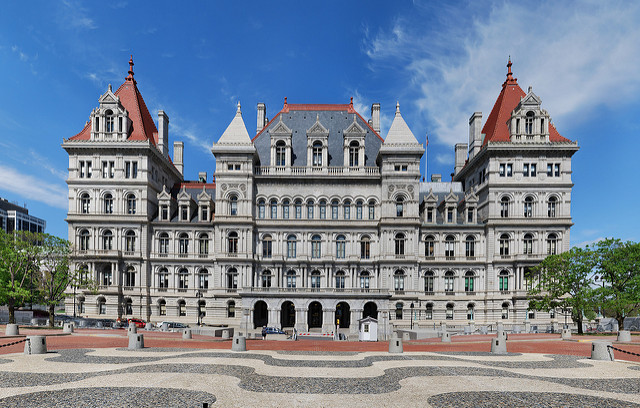
The New York State Capitol building in Albany. Photo credit: Matt Wade
A New York State commission’s decision to define media relations work as lobbying has both journalists and PR pros up in arms — and for once on the same side.
New York’s Joint Commission on Public Ethics voted to expand the definition of lobbying to include communications between the PR firms and the media. Its proposal reads: “Any attempt by a consultant to induce a third party — whether the public or the press — to deliver the client’s lobbying message to a public official would constitute lobbying …”
PR firms hired to influence public policy will be required to register as lobbyists and file reports with the state on their media outreach efforts. The New York governor’s office will review the proposal.
Both PR organizations and media editorials called the proposal interference in the freedom of the press and a drastic over-reach that has nothing to do with combatting political corruption.
Regulating the First Amendment?
The New York Post was especially scathing. “After years of helping hide Albany corruption, a band of loose-cannon bureaucrats has taken on a new mission: ‘regulating’” the First Amendment,” stated the Post’s editorial board.
The newspaper urged it to tackle political corruption at the state capital, which it so far failed to do.
“With the capital a notorious cesspool of corruption for lo, these many years, New Yorkers have rightly viewed the state’s ethics ‘watchdog, as a mere joke,” stated another New York Post editorial. “But now the Joint Commission on Public Ethics is poised to do real damage.”
The PRSA called the decision “an overbroad standard” that would have “chilling effect” on public communication. It is ambiguous, poorly written and only increases confusion and will actually lead to less trust in the government, said PRSA national chair Mark McClennan said in the statement.
“The opinion issued today reflects a complete lack of understanding of the role of public relations consultants and their relationships with the press,” said PR Council President and CEO Renee Wilson. “Public relations professionals who seek to stimulate press coverage on behalf of their clients can provide journalists with information, opinions and access, but they cannot control what will actually be covered by the press, how and when.”
The commission argued that the change is not meant to affect a reporter’s ability to gather information or seek comments from advocacy groups. “Rather, this is intended to generate transparency in the activities of paid media consultants who are hired to proactively advance their client’s interests through the media,” it stated.
No one is convinced. Crain’s reported that one PR firm, The November Group, said it will refuse to comply with the guideline. Litigation against the ruling is possible or even likely.
Bottom Line: A New York ruling requiring PR firms to register as lobbyist and report media communications has roused fierce opposition. Calling the requirement unconstitutional, some opponents vow to disobey the rule. Litigation is a strong possibility.


William J. Comcowich founded and served as CEO of CyberAlert LLC, the predecessor of Glean.info. He is currently serving as Interim CEO and member of the Board of Directors. Glean.info provides customized media monitoring, media measurement and analytics solutions across all types of traditional and social media.

Trackbacks/Pingbacks